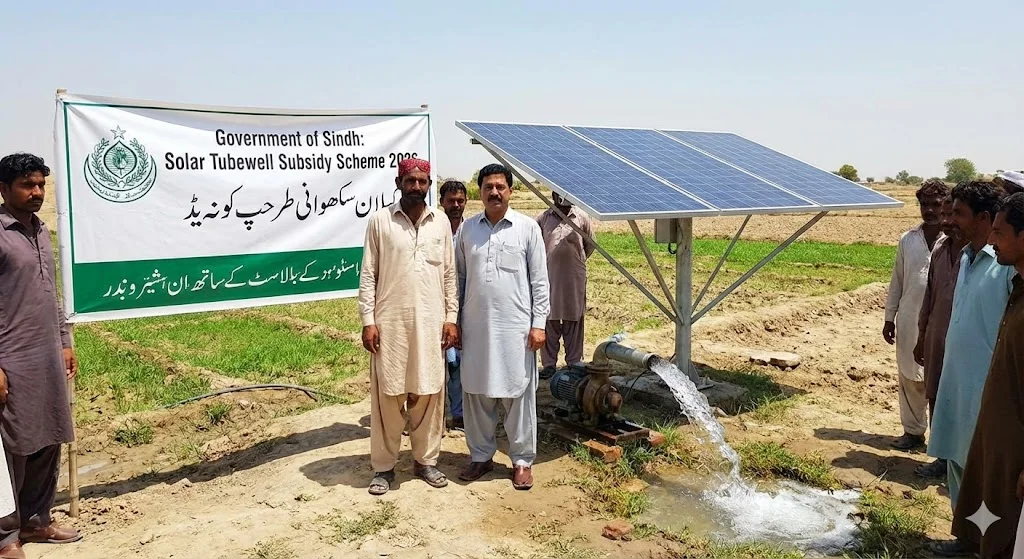
The Solar Tubewell Subsidy Scheme, an initiative vital for agricultural sustainability, has been announced by the Sindh Agriculture Department for 2026. This significant program aims to provide local farmers with access to affordable solar irrigation solutions. It is a strategic component of broader governmental endeavors to alleviate the burden of high fuel and electricity costs, champions the adoption of clean energy practices, and ultimately enhance agricultural productivity across the province.
Unveiling the Solar Tubewell Subsidy Scheme for Sindh Farmers
The Sindh Agriculture Department’s 2026 initiative is designed to empower farmers by reducing their operational expenses. Through this comprehensive subsidy, the government undertakes to cover a substantial portion of the installation costs for solar-powered tubewells, leaving farmers responsible for a fixed, subsidized share. This solar tubewell subsidy is a critical step towards modernising irrigation infrastructure and fostering energy independence within the farming community.
Understanding the Solar Tubewell Subsidy and Farmer Share Costs
Under the new 2026 scheme, the financial burden on farmers for installing solar irrigation systems is significantly reduced. Farmers are required to pay only a pre-determined subsidized amount, while the remaining installation expenses are borne by the government. This structured approach makes advanced solar technology more accessible. For detailed information on various schemes and subsidies, farmers can also refer to resources like Schemess.com.
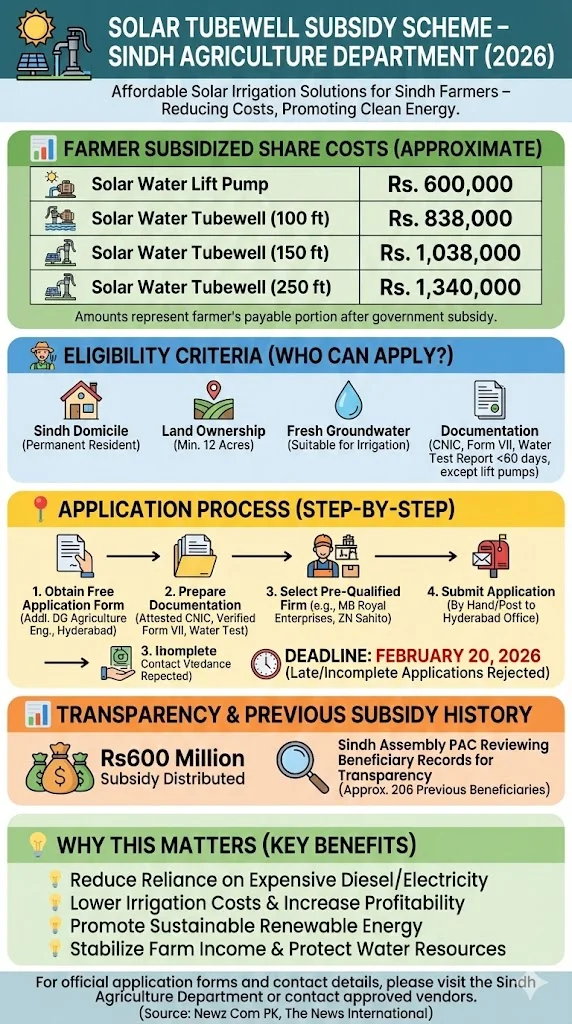
Here’s an approximate breakdown of the farmer’s share for different system types under the solar tubewell subsidy:
| System Type | Farmer Share (Approximate) |
|---|---|
| Solar Water Lift Pump | Rs. 600,000 |
| Solar Water Tubewell (100 ft) | Rs. 838,000 |
| Solar Water Tubewell (150 ft) | Rs. 1,038,000 |
| Solar Water Tubewell (250 ft) | Rs. 1,340,000 |
These figures represent the amount farmers contribute after the application of the government subsidy. This tiered structure ensures that the solar tubewell subsidy caters to diverse farming needs based on the required depth and capacity of the irrigation system.
Eligibility Criteria for the Solar Tubewell Subsidy Scheme
To ensure that the benefits of the solar tubewell subsidy reach deserving farmers, specific eligibility criteria have been established. Prospective applicants must meet these requirements to qualify for the program, which focuses on sustainable agricultural development in the region.
Key eligibility parameters for the solar tubewell subsidy include:
- Sindh Domicile: All applicants must possess permanent resident status in Sindh province, verifiable through official documentation.
- Land Ownership: Farmers are required to own a minimum of 12 acres of agricultural land, a criterion designed to support mid-to-large-scale farming operations.
- Fresh Groundwater: The proposed tubewell must access fresh groundwater suitable for irrigation purposes. A water quality report is mandatory for all tubewell applications, though not required for solar water lift pumps.
- Documentation: Applicants must provide a valid Computerized National Identity Card (CNIC) and an attested copy of Land Revenue Form VII (Deh/Tappa) to verify land ownership.
- Water Test Report: For tubewell installations (excluding lift pumps), a laboratory water test report, issued no more than 60 days prior to the application, is compulsory. This ensures the water harnessed is appropriate for crop irrigation.
Streamlined Application Process for the Solar Tubewell Subsidy
Farmers interested in availing the solar tubewell subsidy must adhere to a clear and structured application process. This systematic approach is designed to facilitate smooth processing and allocation of the subsidy.
The application steps for the solar tubewell subsidy are as follows:
- Obtain Application Forms: Forms are available free of charge at the office of the Additional Director General, Agriculture Engineering (Lower Sindh), located in Shahbaz Building, Hyderabad.
- Prepare Documentation: Applicants must compile all required documents, including attested copies of their CNIC, verified Form VII, and the necessary water test report for tubewells.
- Select a Pre-Qualified Firm: Farmers must choose an approved vendor from the list of pre-qualified firms to carry out the installation. Reputable firms such as MB Royal Enterprises and ZN Sahito are among the approved options.
- Submit Application: The complete application file must be submitted in person or via registered post to the Hyderabad office.
- Submission Deadline: All applications must be received by February 20, 2026. Late or incomplete submissions will not be accepted, underscoring the importance of timely submission for the solar tubewell subsidy.
Ensuring Transparency in Solar Tubewell Subsidy Allocation
Previous phases of the solar tubewell subsidy program in Sindh saw the agriculture department distribute approximately Rs600 million to farmers. Reports indicate that around 206 farmers have benefited from these earlier initiatives, highlighting the scheme’s potential impact. However, the Sindh Assembly’s Public Accounts Committee (PAC) has recently raised concerns regarding transparency. The PAC has requested detailed records of beneficiaries and extensive documentation concerning the allocation of these funds, emphasizing the need for robust oversight in future solar tubewell subsidy distributions.
The Transformative Impact of Solar Tubewell Subsidy Solutions
The strategic decision by the Sindh government to subsidize solar-powered tubewells is poised to usher in a new era of agricultural efficiency and sustainability. This solar tubewell subsidy is not merely a financial aid; it represents a commitment to modernizing the agricultural sector and insulating farmers from volatile energy markets.
Key benefits of the solar tubewell subsidy include:
- Reduced Reliance on Costly Fuels: Farmers will significantly decrease their dependence on expensive diesel and unreliable grid electricity, leading to substantial savings.
- Lower Irrigation Costs: By utilizing free solar energy, the operational costs associated with irrigation will plummet, directly impacting farmers’ profitability.
- Promotion of Sustainable Energy: The initiative actively promotes the adoption of renewable and clean energy sources in the agriculture sector, contributing to environmental protection.
- Stabilized Farm Income: With predictable and lower irrigation expenses, farm incomes are expected to become more stable and predictable.
- Protection of Water Resources: Efficient solar-powered systems can help in the judicious use of water, especially crucial in areas facing water scarcity or unreliable electricity supply, thereby enhancing water resource management.
The solar tubewell subsidy is poised to be a cornerstone in building a resilient and sustainable agricultural future for Sindh.
Frequently Asked Questions about the Solar Tubewell Subsidy Scheme
1. What is the primary goal of the Solar Tubewell Subsidy Scheme 2026?
The scheme aims to support Sindh farmers with affordable solar irrigation solutions, reduce high fuel and electricity costs, promote clean energy, and improve agricultural productivity.
2. How much does a farmer typically pay for a solar tubewell under the subsidy?
The farmer’s share varies by system type. For instance, a solar water lift pump costs approximately Rs. 600,000, while a 250 ft solar water tubewell costs around Rs. 1,340,000 after the government subsidy is applied.
3. What are the main eligibility requirements for the solar tubewell subsidy?
Applicants must be permanent residents of Sindh, own a minimum of 12 acres of agricultural land, ensure the tubewell accesses fresh groundwater (with a water quality report for tubewells), and provide a valid CNIC and Land Revenue Form VII.
4. Where can farmers obtain application forms for the solar tubewell subsidy?
Application forms are available free of charge at the office of the Additional Director General, Agriculture Engineering (Lower Sindh), Shahbaz Building, Hyderabad.
5. What is the deadline for submitting applications for the 2026 scheme?
The deadline for submitting all applications for the solar tubewell subsidy is February 20, 2026. Late or incomplete applications will not be considered.
6. Have there been any concerns regarding previous subsidy distributions?
Yes, the Sindh Assembly’s Public Accounts Committee (PAC) has requested detailed records and documentation concerning previous solar tubewell subsidy allocations, highlighting concerns about transparency.
7. How does this solar tubewell subsidy benefit the environment?
By promoting solar energy, the scheme reduces reliance on fossil fuels like diesel and grid electricity, thereby lowering carbon emissions and supporting a cleaner, more sustainable agricultural sector.
Conclusion
The Solar Tubewell Subsidy Scheme for 2026, spearheaded by the Sindh Agriculture Department, marks a significant step towards modernizing agriculture and fostering sustainability in the region. By offering crucial financial assistance, the scheme aims to reduce the economic burden on farmers, enhance their productivity, and champion the adoption of renewable energy. While past transparency concerns have been raised by the PAC, the clear parameters and structured application process for the 2026 initiative indicate a commitment to efficient and accountable distribution. The successful implementation of this solar tubewell subsidy has the profound potential to transform Sindh’s agricultural landscape, leading to increased farmer profitability, reduced environmental impact, and a more secure food future for the province.