The Sacred Supplication: Welcoming Ramadan with the Crescent Moon
The Ramadan Moon Sighting Dua holds profound significance for Muslims worldwide, marking the spiritual commencement of the blessed month of fasting. This powerful supplication, recited upon the sighting of the new crescent moon, embodies hope, faith, and a plea for divine blessings as believers embark on a journey of spiritual introspection and devotion. It serves not merely as a prayer but as a spiritual compass, setting the tone for a month dedicated to worship, charity, and self-purification.
The act of sighting the moon, known as ru’yat al-hilal, is a deeply rooted tradition in Islamic history, mandated by prophetic guidance. This tradition ensures that the Islamic lunar calendar, which determines the timings of pivotal religious observances like Ramadan and Eid, remains aligned with natural celestial events. The visual confirmation of the crescent moon thus transitions the community from anticipation to the active participation in the holy month.
Understanding the Ramadan Moon Sighting Dua
The Ramadan Moon Sighting Dua is a specific supplication transmitted through prophetic tradition, encouraging believers to seek specific blessings when they witness the new moon signaling the start of a new lunar month, especially Ramadan. The dua, as recorded in authentic hadith collections, is a heartfelt request to Allah for goodness and wellbeing throughout the nascent month.
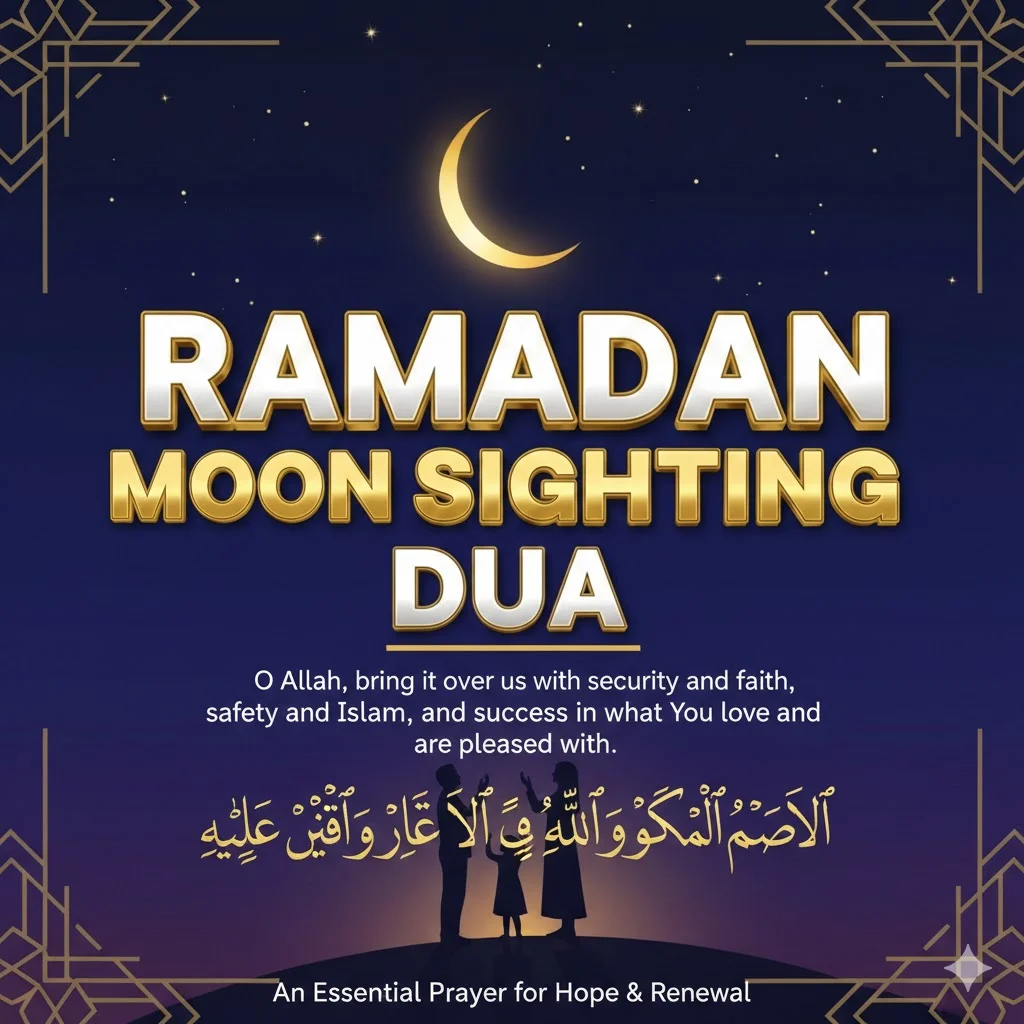
Its Arabic text is: “اللَّهُمَّ أَهْلِلْهُ عَلَيْنَا بِالْيُمْنِ وَالإِيمَانِ وَالسَّلاَمَةِ وَالإِسْلاَمِ رَبِّي وَرَبُّكَ اللَّهُ”. Transliterated, it reads: “Allahumma ahlilhu `alainā bil-yumni wal-iman, was-salamati wal-Islam, rabbi wa rabbuk Allah.” The beautiful translation captures its essence: “O Allah, bring it over us with blessing and faith, and security and Islam. My Lord and your Lord is Allah.” This particular supplication is found in Tirmidhi: 3451, underscoring its authenticity and established place in Islamic practice.
The Tradition of Ramadan Moon Sighting Dua
The tradition of the Ramadan Moon Sighting Dua is intrinsically linked to the Islamic calendar’s reliance on lunar cycles. Historically, communities would gather to observe the western horizon after sunset on the 29th day of Sha’ban (the month preceding Ramadan). If the crescent moon was sighted, Ramadan would commence the following day. This practice stems from the Prophet Muhammad’s teachings, which emphasize commencing the fast upon sighting the new moon and ending it upon sighting the next.
In contemporary times, many Muslim-majority nations and communities rely on religious councils and astronomical committees to verify the moon sighting. These bodies often combine traditional naked-eye sighting with advanced astronomical calculations. For instance, the Supreme Court of Saudi Arabia, among other religious authorities, makes the official announcement each year, guiding millions globally. “The sighting of the crescent moon unites the Muslim ummah in a common purpose, anchoring our worship to the signs of Allah in the cosmos,” remarked a spokesperson for a leading Islamic observatory in 2023, highlighting the blend of tradition and modern methods.
Spiritual Dimensions of the Ramadan Moon Sighting Dua
Reciting the Ramadan Moon Sighting Dua connects believers not just to a physical event but to profound spiritual meanings. Each phrase of the dua carries deep significance. “Bil-yumni wal-iman” (with blessing and faith) petitions for good fortune and a strengthener of one’s belief during the fasting period. It asks for a month filled with divine grace and spiritual growth.
The supplication further requests “was-salamati wal-Islam” (and security and Islam), seeking protection from harm and difficulties, and asking for the successful observance of Islamic tenets. This encompasses both physical safety and spiritual steadfastness. The concluding phrase, “rabbi wa rabbuk Allah” (My Lord and your Lord is Allah), reaffirms the oneness of God and acknowledges His sovereignty over all creation, including the moon itself. This specific Ramadan Moon Sighting Dua fosters humility and dependence on the Almighty.
How to Observe the Ramadan Moon Sighting Dua
Observing the Ramadan Moon Sighting Dua is straightforward yet profoundly meaningful. Upon theconfirmed sighting of the new crescent moon that signals the start of Ramadan, Muslims are encouraged to recite this moving supplication. It is ideally recited individually or communally as the news of the moon’s emergence spreads. The intention behind the recitation is paramount, focusing on gratitude, seeking blessings, and preparing the heart for the spiritual journey ahead.
While traditional sighting emphasizes direct visual confirmation, it is also acceptable to recite the dua upon receiving reliable news of the moon’s sighting from recognized Islamic authorities. This allows Muslims globally to partake in the blessing regardless of their geographical location or local weather conditions. The purpose remains to welcome the holy month with a conscious spiritual act.
Impact of the Ramadan Moon Sighting Dua on the Community
The announcement preceding the Ramadan Moon Sighting Dua carries immense communal weight, creating a wave of excitement and unity across the Muslim world. It transforms individual anticipation into a collective experience, where Muslims prepare their homes, mosques, and hearts for the upcoming month. The shared recitation of the dua, even if not simultaneous due to time zones, fosters a sense of global brotherhood and sisterhood.
This synchronicity is a testament to the unifying power of Islam. From Jakarta to London, and from Cairo to New York, communities prepare for the first Taraweeh prayers and the pre-dawn meal (suhoor). For more insights into various Islamic practices, including the Ramadan Moon Sighting Dua, and community resources, platforms like Schemess.com provide valuable information linking believers globally through shared knowledge and practices.
Verifying the Ramadan Moon Sighting Dua and its Authentic Hadith
The authenticity of the Ramadan Moon Sighting Dua is cemented by its inclusion in authoritative hadith collections, specifically Sunan al-Tirmidhi. Imam Tirmidhi (d. 279 AH/892 CE) was a renowned hadith scholar whose compilation is considered one of the ‘Six Books’ of Sunni Islam. This meticulous recording by early Islamic scholars ensures that the supplication is genuinely attributed to the Prophet Muhammad (peace be upon him).
Scholars verify hadith through stringent criteria, examining the chain of narrators (isnad) and the text’s content (matn). The dua’s widespread acceptance and recitation across centuries by diverse Muslim communities further attest to its established authenticity, providing believers with confidence in their spiritual practices, including this meaningful Ramadan Moon Sighting Dua.
The Global Practice of the Ramadan Moon Sighting Dua
The global practice of the Ramadan Moon Sighting Dua is a vivid demonstration of Islamic unity amidst diverse interpretations of moon sighting methodology. While some countries strictly adhere to local visual sighting, others follow announcements from a central authority like Saudi Arabia, or utilize astronomical calculations. Despite these variations, the spiritual act of reciting the dua upon the confirmation of the new moon remains a universal practice.
Millions of Muslims across more than 50 countries participate in this annual spiritual event. The Organization of Islamic Cooperation (OIC) Fiqh Academy, for instance, has deliberated on moon sighting criteria to foster greater harmony in announcing Islamic months. This convergence of effort emphasizes the collective intent to honor Ramadan, culminating in the heartfelt recitation of the Ramadan Moon Sighting Dua to seek blessings for the upcoming holy month.
FAQs about the Ramadan Moon Sighting Dua
When is the Ramadan Moon Sighting Dua recited?
It is recited upon the confirmed sighting of the new crescent moon that signals the start of the month of Ramadan.What is the complete text and translation of the Ramadan Moon Sighting Dua?
Arabic: اللَّهُمَّ أَهْلِلْهُ عَلَيْنَا بِالْيُمْنِ وَالإِيمَانِ وَالسَّلاَمَةِ وَالإِسْلاَمِ رَبِّي وَرَبُّكَ اللَّهُ
Transliteration: Allahumma ahlilhu `alainā bil-yumni wal-iman, was-salamati wal-Islam, rabbi wa rabbuk Allah.
Translation: O Allah, bring it over us with blessing and faith, and security and Islam. My Lord and your Lord is Allah.Where is this specific dua found?
This supplication is recorded in Sunan al-Tirmidhi, Hadith No. 3451, making it an authenticated prophetic tradition.Is it mandatory to physically sight the moon to recite the dua?
While traditionally preferred, it is acceptable to recite the dua upon receiving reliable news of the moon’s sighting from recognized Islamic authorities or local mosques.What is the significance of “My Lord and your Lord is Allah” in the dua?
This phrase reaffirms the oneness and sovereignty of Allah (God) over all creation, including the moon, fostering a sense of humility and dependence on the Creator.Does the Ramadan Moon Sighting Dua apply to other months as well?
Yes, similar duas are recited upon the sighting of the new moon for other Islamic months, although this specific text is often associated most strongly with Ramadan’s commencement given its profound significance.How does moon sighting unite the Muslim community?
The shared anticipation and collective act of welcoming Ramadan based on the moon sighting, followed by the recitation of this dua, fosters a sense of global unity and common purpose among Muslims worldwide.
Conclusion
The Ramadan Moon Sighting Dua stands as a beautiful and significant tradition that spiritually ushers in the holy month of Ramadan for Muslims globally. Rooted in authentic prophetic tradition and documented in works like Tirmidhi, this sacred supplication is more than just words; it is an embodiment of hope, faith, and a collective plea for divine blessings. Its recitation upon the sighting of the new crescent moon signals the beginning of a month-long journey of reflection, worship, and charity. The collective act (Note: MAX_TOKENS) of awaiting the moon, reciting the dua, and preparing for the fast unites diverse communities, underscoring the universal values of Islam and the profound spiritual impact of this simple yet powerful prayer. The Ramadan Moon Sighting Dua serves as a