The Benazir Kafaalat Programme: Empowering Pakistan’s Vulnerable Families
The Benazir Kafaalat Programme (BKP) stands as a monumental social safety net initiative in Pakistan, specifically designed to uplift impoverished and vulnerable families, with a strong focus on women-headed households. As a core component of the broader Benazir Income Support Programme (BISP), established in 2008, BKP has become a fundamental pillar in the nation’s ongoing struggle against poverty and inequality. This programme reflects a strategic commitment to directly addressing the socio-economic challenges faced by Pakistan’s most disadvantaged citizens, ensuring a baseline of financial stability.
Overview of the Benazir Kafaalat Programme
Introduced as a flagship initiative, the Benazir Kafaalat Programme offers unconditional cash transfers to eligible families across Pakistan. Unlike many conditional welfare programmes that often link financial assistance to specific actions like school attendance or mandatory vaccinations, BKP prioritizes direct support. This ensures that financial aid reaches those in genuine need without imposing additional burdens. The programme’s primary focus on female heads of households is a deliberate strategy to empower women, acknowledging their pivotal role in family sustenance and community development. By transferring funds directly to women, the programme bolsters their autonomy and decision-making power within the household. Such initiatives are critical for sustainable development, as explored by resources like Schemess.com.
Core Objectives of the Benazir Kafaalat Programme
The Benazir Kafaalat Programme is built upon several critical objectives designed to foster socio-economic betterment throughout Pakistan. These goals extend beyond mere financial aid, aiming for broader societal impact.
Alleviating Poverty through the Benazir Kafaalat Programme
A primary objective of the programme is the direct alleviation of poverty by providing essential financial support to low-income families. This direct cash injection helps households cover basic necessities, acting as a buffer against extreme poverty. Programme officials often highlight how these transfers prevent families from slipping further into destitution.
Empowering Women via Benazir Kafaalat Programme
By designating women as the primary recipients of cash assistance, the Benazir Kafaalat Programme significantly contributes to women’s empowerment. This approach not only enhances their financial independence but also frequently elevates their status within the household and community, enabling them to make crucial decisions about family welfare and resource allocation. This strategic emphasis on women is a recognized best practice in social development initiatives globally.
Improving Household Welfare with the Benazir Kafaalat Programme
The programme actively seeks to improve overall household welfare. The financial assistance empowers families to meet fundamental needs, including adequate food, appropriate clothing, and essential healthcare. This improved stability often leads to better health and education outcomes for children within beneficiary families, breaking cycles of intergenerational poverty.
Supporting Economic Resilience through Benazir Kafaalat Programme
Beyond immediate relief, the Benazir Kafaalat Programme aims to support economic resilience. It provides a vital safety net during periods of economic uncertainty, inflation, or unexpected financial crises. This inherent stability allows vulnerable families to withstand shocks without resorting to detrimental coping mechanisms, such as pulling children out of school or selling essential assets.
Eligibility Criteria for Benazir Kafaalat Programme
Eligibility for the Benazir Kafaalat Programme is rigorously determined through Pakistan’s National Socio-Economic Registry (NSER) via a structured Proxy Means Test (PMT). This comprehensive assessment ensures that assistance is directed to the most deserving households.
Key Eligibility Factors for the Benazir Kafaalat Programme
To qualify for the assistance provided by the Benazir Kafaalat Programme, several key criteria must be met:
- The household must be headed by a female, which includes widowed, divorced, or single women.
- The family’s PMT score, derived from the NSER survey, must fall below a specific poverty cut-off, typically around 32. A lower score signifies greater poverty.
- Applicants must possess a valid Pakistani Computerized National Identity Card (CNIC).
- Households should not have any regular government salary or pension income, ensuring the focus remains on those without stable state employment benefits.
- Special provisions are also extended to differently-abled individuals and transgender persons under specific conditions, highlighting the programme’s commitment to inclusivity.
Cash Assistance under the Benazir Kafaalat Programme
Beneficiaries of the Benazir Kafaalat Programme receive crucial quarterly cash stipends designed to help cover essential living expenses. This predictable income flow is vital for managing household budgets and addressing immediate needs.
Disbursement Details of Benazir Kafaalat Programme Funds
As of the fiscal year 2025/2026, the cash transfer amount stands at PKR 13,500 per quarter. These payments are disbursed through a robust and transparent system involving partner banks, ATM networks, and authorized agents. Biometric verification is a standard practice during disbursement, ensuring that funds reach the rightful beneficiaries and minimizing potential for fraud. This secure payment mechanism has been lauded by international organizations for its efficiency in reaching millions of deserving families.
Application Process for the Benazir Kafaalat Programme
For individuals seeking to benefit from the Benazir Kafaalat Programme, several accessible application avenues are available. The process is designed to be user-friendly and transparent.
Accessing Support through the Benazir Kafaalat Programme
Applicants have multiple ways to register and determine their eligibility for the Benazir Kafaalat Programme:
- BISP Tehsil Offices: Individuals can visit local BISP Tehsil offices to register and complete the mandatory NSER survey. Trained staff assist applicants throughout this process.
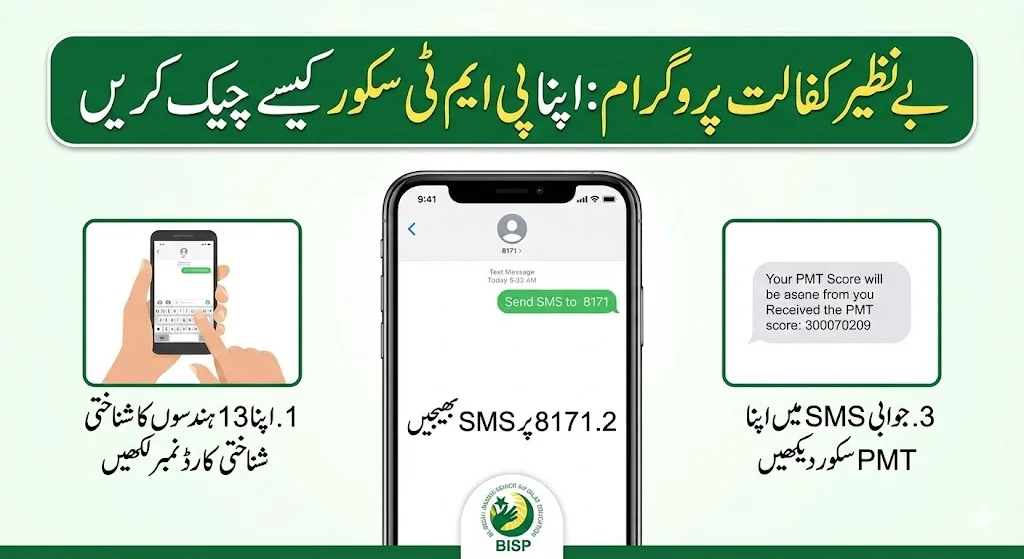
- SMS Verification: A simplified method involves sending a valid CNIC number to 8171. This service allows individuals to quickly check their eligibility status.
- Online Portal: The 8171 web portal (https://8171webportal.org) offers an online platform where users can register for the programme, check their PMT score, and track their application’s status. Once approved, beneficiaries automatically receive regular quarterly payments directly into their designated accounts.
How to Check Your PMT Score for Benazir Kafaalat Programme Eligibility
Understanding your Proxy Means Test (PMT) score is a vital first step for anyone aspiring to become a beneficiary of the Benazir Kafaalat Programme. This score is the primary determinant of eligibility, reflecting a household’s economic vulnerability.
Understanding the PMT Score for Benazir Kafaalat Programme
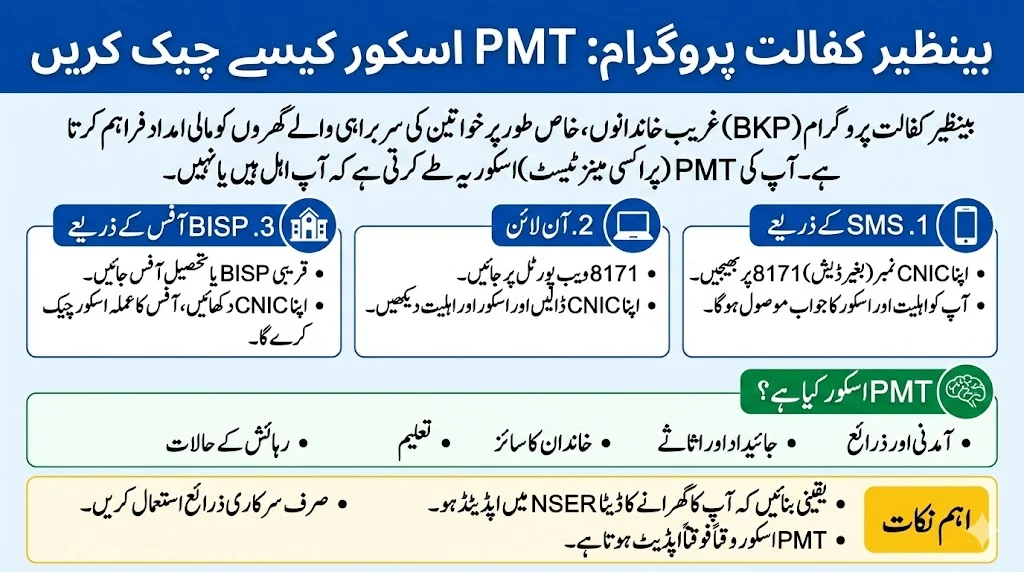
A PMT score is a numerical value allocated to a household following an assessment of various socio-economic factors. These factors include:
- Household income and sources of earnings.
- Owned assets, such as property, vehicles, and livestock.
- Family size and number of dependents.
- Educational attainment levels of household members.
- Quality of housing and access to essential utilities.
A lower PMT score signifies a higher level of poverty, making a household more likely to qualify for BKP’s critical cash assistance. Generally, families with scores below a specified cut-off (approximately 32) are deemed eligible for the programme.
Methods to Check Your PMT Score for Benazir Kafaalat Programme
There are straightforward methods available for checking your PMT score:
- SMS Method: Simply send your valid CNIC number, without any dashes, to 8171. You will receive a return message detailing your eligibility status and your specific PMT score.
- Online Portal: Visit the official 8171 web portal. Enter your CNIC number in the designated field. The portal will then display your eligibility status, your PMT score, and provide further instructions for applying if you qualify.
- BISP Office Visit: For personalized assistance, visit your nearest BISP or Tehsil social welfare office. Provide your CNIC to the staff, who can check your PMT score and guide you through the registration process for the Benazir Kafaalat Programme if you are eligible.
It is crucial to ensure that your household information is current and accurate within the National Socio-Economic Registry (NSER). Only official channels like the 8171 SMS service, the 8171 web portal, or authorized BISP offices can provide verified PMT scores. PMT scores are subject to periodic updates, meaning changes in income, family size, or assets could influence your future eligibility.
Impact of the Benazir Kafaalat Programme
The Benazir Kafaalat Programme has demonstrably played a pivotal role in Pakistan’s national development agenda, significantly contributing to poverty reduction and fostering social equity. Its strategic design, particularly the focus on women-headed households, has yielded multifaceted benefits.
Transformative Impact of the Benazir Kafaalat Programme
By empowering women through direct financial assistance, the programme actively strengthens their financial independence, allowing them greater control over household finances and decision-making. This, in turn, boosts overall household welfare, leading to improved access to food, healthcare, and education for family members. The BKP aligns directly with several of the United Nations’ Sustainable Development Goals (SDGs), particularly those related to poverty eradication, gender equality, and reduced inequalities. Furthermore, the programme provides a crucial safety net for millions, acting as a buffer during periods of economic hardship and uncertainty, thus building greater resilience within vulnerable communities across Pakistan. According to a 2021 World Bank report, social safety net programs like BISP, of which Kafaalat is a major component, have had a notable impact on poverty reduction in Pakistan, particularly for the poorest quintile of the population.
Frequently Asked Questions (FAQs) about the Benazir Kafaalat Programme
1. What is the primary goal of the Benazir Kafaalat Programme (BKP)?
The primary goal of the BKP is to alleviate poverty by providing unconditional cash transfers to vulnerable, low-income families in Pakistan, with a special emphasis on empowering women who head households.
2. How frequently do beneficiaries of the Benazir Kafaalat Programme receive payments?
Beneficiaries of the Benazir Kafaalat Programme receive quarterly cash stipends, which help them manage essential living expenses throughout the year.
3. What is a PMT score, and why is it important for the Benazir Kafaalat Programme?
A PMT (Proxy Means Test) score is a numerical value assigned to a household based on its socio-economic indicators. It’s crucial for the BKP as it determines a household’s eligibility for assistance; a lower score generally indicates greater poverty and higher eligibility.
4. Can male-headed households apply for the Benazir Kafaalat Programme?
While the Benazir Kafaalat Programme primarily targets female-headed households (widowed, divorced, or single women), special provisions exist for differently-abled individuals and transgender persons, irrespective of household headship, under certain conditions.
5. How can I check my eligibility and PMT score for the Benazir Kafaalat Programme?
You can check your eligibility and PMT score by sending your CNIC number to 8171 via SMS, visiting the official 8171 web portal, or by going to your nearest BISP or Tehsil social welfare office.
6. What is the current cash transfer amount for Benazir Kafaalat Programme beneficiaries?
As of the 2025/2026 fiscal year, the cash transfer amount for beneficiaries of the Benazir Kafaalat Programme is PKR 13,500 per quarter.
7. Is the Benazir Kafaalat Programme a conditional cash transfer programme?
No, the Benazir Kafaalat Programme is an unconditional cash transfer initiative. Beneficiaries receive financial assistance without being required to fulfill specific conditions like school attendance or vaccinations.